Posts

SEEKING FORGIVENESS FOR GHEEBAT (BACKBITING)? - 5 (a talk by Mufti Taqi Usmani DB)

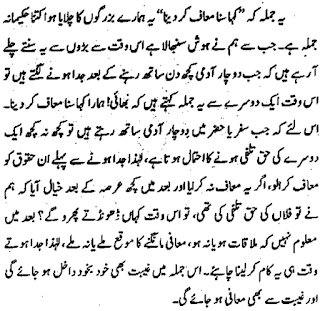
  Learning about one’s own flaws   I heard it from Dr Abdul Hai (may Allah have mercy on him) that Hadhrat Thanvi (may Allah mercy on him) used to say that whenever someone says to me, “I have committed your  Gheebat , please forgive me”, then I always say to him, “I will forgive you but please first tell me what you had said about me.” The person whose  Gheebat  was committed has a right to ask what was said. He used to say that the reason I ask this is that sometimes  Gheebat  is true. It is not necessary that  Gheebat  is always wrong. So, this way sometimes I come to know about my own flaws.

غیبت کی معافی کا طریقہ: ۵ از حضرت مولانا مفتی محمد تقی عثمانی دامت برکاتہم

Image
 

AL-BAQARAH (The Cow) - 29

  So, if they believe in the same way as you believe, they will have certainly found the right path, and if they turn away, then the fact is that they are in antagonism. Then Allah will suffice you against them, and He is the All-Hearing, the All- Knowing. (2:137)    This verse defines  ‘Iman’  (faith) in a very simple yet very comprehensive way. The immediate addressees of the phrase "you believe" are the Holy Prophet  ﷺ  and his blessed Companions. Thus, in matters of faith, their  Iman  has been placed before us as a model, and the verse is essentially a divine commandment, laying down the fundamental principle that the only  Iman  acceptable to Allah Ta’ala is the one which was adopted by the Holy Prophet  ﷺ  and his blessed Companions, and that any doctrines or beliefs that deviate from it in the least are neither valid nor acceptable to Allah.

SEEKING FORGIVENESS FOR GHEEBAT (BACKBITING)? - 4 (a talk by Mufti Taqi Usmani DB)

  Please forgive me for anything I may have said   When we were growing up, we saw our elders that after they had spent some time with someone, when they were parting they would say something like, “please forgive me if I have said anything that may have hurt you”. It is because when people spend some time with each other it is bound to happen that one person would have said something at some point that would have upset the other. That is why it is best to get all that forgiven before parting. If you don’t, and then after a period of time you realize that you need to ask them to forgive you for something, where would you find them? Who knows whether you will ever meet them again or not, or whether you will get the chance to apologize to them or not? That is why it is important to make a habit of saying something like this at the time of parting from someone you have spent some time with. This will be inclusive of  Gheebat  and  Gheebat  will be automaticall...

غیبت کی معافی کا طریقہ: ۴ از حضرت مولانا مفتی محمد تقی عثمانی دامت برکاتہم

Image
 

AL-BAQARAH (The Cow) - 28

 4 .       “and make them pure”   The Arabic word  Tazkiyah  denotes purifying a thing or person from all kinds of filth, internal as well as external. The external kinds of filth are easier to understand. The internal varieties include, on the one hand, disbelief in Allah ( Kufr ), and association ( Shirk ), and, on the other hand, pride, vanity ( تکبّر ), malice ( بغض ), jealousy ( حسد ), love of worldly things ( حبّ دنیا ), etc.    Although the evil nature of such beliefs and tendencies has been fully explained in the Holy Qur'an and the Sunnah, yet in making "the purification of the people" a distinct and separate prophetic function the present verse indicates that this purification of inner-self cannot be achieved just by reading about it, it can only be learnt and internalized by practicing it under the supervision of a mentor.

SEEKING FORGIVENESS FOR GHEEBAT (BACKBITING)? - 3 (a talk by Mufti Taqi Usmani DB)

  The gravity of Huqooq al-Ibad   The way of seeking forgiveness for and repenting from the sins which belong to the category of  Huqooq-Ullah  (rights of Allah), such as drinking alcohol or committing adultery, is that a person feels genuine remorse about them, begs for forgiveness from and repents to Allah Ta’ala, and makes a sincere commitment and intention never to commit those sins in the future. Insha’Allah these will be forgiven. On other hand, the rule for  Huqooq al-Ibad  (rights of people) is that they are not forgiven until that person whose rights have been violated, forgives first.  Gheebat  is also included in  Huqooq al-Ibad . So, even if a person begs to Allah Ta’ala with genuine remorse that “I have committed  Gheebat , please forgive me”, the sin of  Gheebat  will not be forgiven till the person whose  Gheebat  he had committed forgives him. That is why Hadhrat Thanvi RE has said that if a person has...